Tag Archive for: Healthcare

Published: July 24, 2015

By Mary Holloway Richard

Q: Sunday is the 25th anniversary of the signing of the federal Americans with Disabilities Act (ADA). What animals are currently considered to be service animals?

A: The definition of “service animal” comes from the ADA and includes animals individually trained to perform tasks for individuals with disabilities. As of 2011, Titles II (state and local government services) and III (public accommodations and commercial facilities) of the ADA recognize only dogs as service animals, although there’s a separate provision about mini-horses. In addition to service dogs, there are sensory or social signal dogs, psychiatric service dogs and seizure response dogs.

Q: Is there a difference between a “service animal” and a “therapy animal?” 

A: Service dogs are trained to perform tasks or to do work for people with disabilities such as guiding the blind, alerting the deaf, pulling a wheelchair, reminding a person with a mental health diagnosis to take medications, or protecting a person who is having a seizure. The work must be directly related to the person’s disability. Therapy animals provide supports and comfort to people in many different types of situations.  There seems to be an impression among some members of the public that the service designation includes untrained animals providing comfort to owners of varying degrees of independence. It is generally true that a mental health provider may provide a letter indicating that a “regular” pet provides emotional support as needed by the owner who has a mental health condition or disability, and special training is not required. An  important distinction is that these are working animals and not pets. In my representation of hospitals over the years, I’ve been asked to advise concerning requests for visitation by a broad array of animals including burros, boutique cattle, and cats to serve specifically as therapy or emotional support animals. Some of the relevant case law from other jurisdictions involves monkeys and one involves a sugar glider, an Australian
opossum-like creature.

Q: Do these rules apply just to hospitals or do they also apply to other types of facilities and providers of health services?

A: The guidelines for service animals also apply to surgery centers, dental clinics, assisted living and long-term care facilities, and urgent care and outpatient clinics. The federal requirement is to allow service animals to accompany persons with disabilities in all areas of a facility or office where the public is normally allowed to go. It’s my experience that hospitals are better prepared than these other sites listed and physician offices to respond to these requests. Hospitals generally have policies and procedures that mirror state and federal laws and industry best practices.

Q: Are there limits to these ADA requirements?

A: When service dogs raise valid concerns about patient safety and quality of care, all providers in their distinct care settings will find it necessary to balance patient, staff, employee and public safety interests. Common valid concerns for institutional and non-institutional providers include infection control, allergies, animal control, safety of others, disruption of care or ability to safely provide quality services. An example of such a concern is a situation where a service dog’s presence is desired in a health care setting but there’s no one to provide the necessary care for the service dog. I also have encountered service animals with open wounds or otherwise in need of veterinary care that posed risks to patient care and to personnel that had to be considered. Another issue that has arisen is a service dog trained to be protective in a manner that impedes care by staff, such as a dog trained to place itself between the patient and others.

By Mary Holloway Richard, JD, MPH

An Illinois appellate court recently upheld a trial court decision granting summary judgment in favor of a hospital in a case where the plaintiff sought to limit a hospital’s statutory peer review immunity.1 Upholding a stringent standard imposed by the trial court, the appeals court ruled that the Illinois peer review statute requires pleading and proof of actual or deliberate intent to harm, or clear indifference to or disregard for, the peer-reviewed physician, along with resulting physical harm to the physician, and that mere harm to reputation is not enough. In this case, OB/GYN Dr. Valfer alleged merely that Evanston Northwest Healthcare (ENH) had failed to follow the proper procedures in dealing with him and that this failure had caused him reputational harm. The appeals court held that this fell short of the showing required to overcome the state law peer review immunity.

Valfer’s medical staff privileges at ENH were renewed in November 2000 for one year and for an additional nine months in September 2001. He re-applied for privileges and was informed that issues had arisen requiring a review of his surgical procedures for the preceding 12 months. In June 2002, Valfer agreed to stop scheduling surgeries at ENH, and his operating privileges were suspended pending resolution of patient safety issues involving unnecessary procedures. Valfer was notified by the service chief that he would not recommend Valfer’s reappointment. In July 2002, the medical executive committee agreed with that recommendation and provided Valfer with written notice of its decision not to reappoint him and also notified him of his hearing rights.

In 2004, an ad hoc hearing was held in which the service chief and another competing physician testified against Valfer. The decision not to appoint was upheld. Valfer appealed the decision to the appellate review committees; the ad hoc committee’s decision was upheld and was affirmed by the Board. Valfer continued to admit patients until the decision not to reappoint became final in March 2005. During the three-year period from Valfer’s final application for reappointment to the effective date of non-reappointment, no changes were made in ENH credentialing software, and he continued to be listed in “good standing” and to admit patients.

In 2007, Valfer sued for civil damages resulting from ENH’s decision not to reappoint him. ENH filed a summary judgment motion seeking to dismiss the breach of contract claim. ENH argued there was no breach as ENH had followed relevant procedures and was immune under both the state statute2 and the federal Health Care Quality Improvement Act (HCQIA).3 The summary judgment motion was granted.

On appeal, Valfer argued that there was, in effect, a reappointment by virtue of his continuing patient admissions and that this raised a question of fact as to ENH’s allegedly improper reliance on reappointment, rather than peer review, procedures. Valfer also characterized HCQIA immunity as limited to peer review and therefore not applicable because of ENH’s alleged reliance upon reappointment, rather than peer review, procedures. He argued that there was no peer immunity because of its willful or wanton denial of his privileges because of peer review by competitors. ENH responded in part that immunity under the Illinois peer review statute applied by virtue of the “willful or wanton” language and in the face of Valfer’s failure to allege physical harm to himself from the decision not to reappoint, and that the four statutory requirements for HCQIA immunity had been met.

In upholding the lower court’s decision the appellate court focused on legislative intent and the clear and unambiguous language of the statute. By giving effect to all statutory language, the court concluded that Illinois statutory immunity exists in the absence of willful or wanton misconduct. The plaintiff’s allegations of breach of contract by ENH for failure to follow the proper bylaws did not satisfy the statutory requirement of willful or wanton misconduct. The court cited precedent for overriding peer review immunity for civil damages where a defendant’s course of action demonstrates actual or deliberate intent to harm others or clear indifference to or disregard for a person and concluded that physical harm must necessarily be alleged and proved in order for a party to be civilly liable for peer review activities.4 According to the court, to require anything less, such as allowing damage to business or reputation to suffice, would make the peer review immunity meaningless and discourage such activities.

While parties often focus on HCQIA as the primary source of peer review immunity, this case illustrates that hospital counsel should not overlook the robust and vital protections that often co-exist under companion state law peer review privileges.


1 Valfer v. Evanston Northwest Healthcare, No. 1-14-2284, IL App (1st) 2015.
2 Ill. Hospital Licensing Act 210 ILCS 85/1 et seq (West 2012).
3 42 U.S.C. 11101 (2012).
4 Valfer at par. 29 citing Larsen v. Provena Hospitals, 2015, IL App (4th) 140255.

On Thursday, June 25, 2015, the United States Supreme Court issued its long-awaited opinion in King et al. v. Burwell, Secretary of Health and Human Services, et al. .[i]  The decision came the week before many of the nation’s foremost health care attorneys met in Washington, D.C. to share information, meet with regulators and network in the interests of their clients.  As you might imagine there was significant discussion about the impact of the decision both in the contexts of formal presentations and hallway conversations.

The decision in this case was considered by some attorneys and commentators to hold the key to the future of the Affordable Care Act (ACA).[ii]   In the King case the ACA’s premium tax credits, as applied to federally financed plans, were challenged.  The premium tax credits worked to reduce the premium amounts for nearly 90% of all persons who have purchased health insurance through the state health insurance marketplace, known as a “health insurance exchange,” which provides consumers the opportunity to compare prices and plans.

The Supreme Court’s 6-3 decision held that the premium tax credits at issue would continue to be available in the dozen or so state-sponsored exchanges as well as in the more than thirty states with federally sponsored exchanges operated by the federal government.  The Court applied familiar theories of statutory interpretation to interpret the both the meaning of the statute and the intent of Congress to make premium tax credits available to individuals enrolled in insurance plans through both state- and federally-operated exchanges.  The Court chose not to defer the interpretation to the federal agency responsible for enforcing the tax credit, the Internal Revenue Service.  This is significant because it effectively forecloses the opportunity for any future administration to alter the interpretation to restrict the premium tax credits to the state-operated exchanges.

The challengers to the ACA language argued that, read literally, the specific ACA language at issue limits premium tax credits to state-operated exchanges only.  Justice Scalia’s twenty-one page dissent was described as scathing by many of us who made presentations at AHLA last week.  Justice Scalia wrote that “[w]ords no longer have meaning if an Exchange that is not established by a State is ‘established by the State.’”[iii]  He also wrote in his dissent, “Perhaps sensing the dismal failure of its efforts to show that ’established by the State’ means ‘established by the State or the Federal Government,’ the Court tries to palm off the pertinent statutory phrase as ‘inartful drafting.’ This Court, however, has no free-floating power to ‘rescue Congress from its drafting errors.’”[iv]

Oklahoma is the site of a federal marketplace where, had the decision come down for the challengers, more than 87,000 persons would have been at risk for losing tax credits, and the state was at risk of losing over $18,000.00 in revenue, according to the Kaiser Family Foundation.[v]  The average tax credit per Oklahoma enrollee is $209.00, and, without the tax credit, there would have been an estimated 243% increase in the average premium.

At least while President Obama is still in office, the Court’s decision in King v. Burwell means that the threats to the ACA will mostly disappear.  The national uninsurance rate is likely to continue to fall because the ACA incentives—the ACA requires individuals to buy health insurance or face a penalty on their taxes and helps them afford health insurance through the premium tax credits. Fewer uninsured presumably also means health care providers will have less uncompensated care.

In the nation and in Oklahoma, we will continue, at least during this administration, generally to see a decreasing uninsured population and less uncompensated care for providers.  However, all of this is in the context of complex, increased regulation such as the proposed regulations for both Medicare and Medicaid that were indirectly and directly respectively spawned by the ACA.  The King decision, so long-awaited, appears to have deflated the opponents to the ACA for the time being.  The Court’s decision also means that the next Presidential and congressional elections may be critical to the fate of the ACA as changes now would only be placed in motion by Congress.


[i]
 576 U.S. ____  (2015), No. 14-114, slip op (June 25, 2015).

[ii] The Patient Protection and Affordable Care Act, 42 U.S.C. §18001 et seq. (2010).

[iii] 567 U.S. at ___-___ (principal opinion) (slip op. dissent, at 2.

[iv] Id. at 17.

[v] Kff.org/interactive/king-v-burwell-effects/

By Mary Holloway Richard, Attorney

shutterstock_healthcareWellness is in the news again.  Large employers have inserted wellness protocols and metrics into the workplace with great enthusiasm.  Advertisements for webinars tout the importance of clinicians and counsel getting on the wellness bandwagon, and articles on the topic appear daily in local and national newspapers.

The wellness debate continues and focuses on these issues:

  1. Financial impact
  2. High risk diseases and conditions subject to detection and prevention such as diabetes, hypertension, obesity and smoking
  3. Impact of economic status on health and ability to access to programs supporting lifestyle change (e.g., no time to attend a course or to exercise.

The Equal Employee Opportunity Commission (“EEOC”) is the federal agency charged with oversight of employer compliance with the Americans with Disability Act (“ADA”) and specifically with guiding employers in properly complying with the ADA in the context of popular wellness programs.  The ADA is, of course, statutory; supporting regulations and interpretive guidelines are issued by the agency.  While the interpretive guidelines do not have the force of law, they are regularly instructive as a window into the agency’s perspective and intent in terms of review and enforcement

Recently, the EEOC proposed a rule change in which it will reverse its own policy on whether or not employer-sponsored wellness programs discriminate against employees.  The EEOC is now saying that such programs do not necessarily discriminate against workers. The agency also indicates that such employers have yet to show the financial benefits of such programs. The EEOC’s proposed rule change would allow for employers to decrease premiums as an incentive for employees to comply with recommended health screenings and to improve their health metrics without violating federal disabilities laws.

Presented in late April, 2015, the EEOC’s  proposed wellness regulations seek to establish how such a program must be structured in order to comply with the ADA’s rule permitting disability-related inquiries and medical exams by a “voluntary health program.”[i]  The proposed regulations require:

  • A cap on an employer-incentive or penalty at 30% of the total cost of employee-only coverage under the plan. [ii] Total cost refers to employer plus employee contributions.
  • Additional requirements for employers offering a wellness program in conjunction with a group health plan, including notice to employees of the medical information to be obtained and by whom and how the information will be used and how safeguards against improper disclosure.
  • New confidentiality provisions to be applied to information obtained in wellness programs by sponsors or wellness vendor.
  • The program itself must be created in such a way as to promote health status, prevent disease and not be overly burdensome on plan participants.

This does not relieve the employers from compliance with HITECH and HIPAA and the Affordable Care Act.  In addition and importantly, employers will be faced with differing requirements by the Internal Revenue Service, the Department of Labor and the Department of Health and Human Service — the agencies responsible for implementing the Affordable Care Act. These inconsistencies may be resolved at the close of the public comment period for these new EEOC proposed regulations. The period for public comment closes on June 19, 2015.


[i] It is likely that most wellness programs will fit into this category.

[ii] The Affordable Care Act’s non-tobacco incentive is held to the same limit for wellness programs including collection of health data.  The additional cap in the proposed regulations is for the same amount for the tobacco incentive for participation-only wellness programs unless the employer does not fall within the purview of the ADA (less than 50 employees.)  The policy ramification is that the EEOC does not distinguish between a tobacco-cessation wellness program where the participants are questioned about their tobacco use from one where a nicotine test is required of them to verify tobacco use or non-use.


Mary feat img 142x177

Author: Mary Holloway Richard is recognized as one of pioneers in healthcare law in Oklahoma. She has represented institutional and non-institutional providers of health services, as well as patients and their families. She also has significant experience in representing providers in regulatory matters.


Healthcare attorney, Mary Holloway Richard published an article about the Sunshine Act in the May/June 2015 issue of the Oklahoma County Medical Society publication, The Bulletin.


CMS seeks to mitigate potential impact on prescribing and treatment practices

Sunshine-Act-MHRThe Physicians Payments Sunshine Act (i) (“Sunshine Act”), despite its name, currently places no direct reporting requirements on physicians. Rather, the Sunshine Act requires that certain manufacturers of prescription drugs, biologic agents, medical devices and medical supplies (“Manufacturers”) and group purchasing organizations (“GPOs”) report to Centers for Medicare and Medicaid Services (“CMS”) payments in specified amounts (ii) and other transfers of value to physicians (iii) and to teaching hospitals (iv). In addition, ownership and investment interests in applicable Manufacturers and GPOs held by physicians (and immediate family members) must be reported annually by applicable Manufacturers and GPOs. Covered payments include cash (or cash equivalent, in-kind items or services), stock (including stock options or ownership interest dividend profit or other return on investment), and other forms of payment to be determined in the future by CMS. While it is not the physician’s duty to report, the reporting requirement directly impacts physicians who receive such payments as their names appear on a list on the CMS website accessible by patients and other consumers (v).

The purpose of the Sunshine Act is to identify potential biases in physician prescribing and treatment practices, to reveal conflicts of interest for clinical researchers and educators, and to identify transactions in which payments involving potential referrals by physicians exceed fair market value. The Sunshine Act creates the Open Payments Program for the actual reporting of the financial payments and transfers of value to physicians. Currently the burden is on the Manufacturers to report payments for consulting fees, contracted services, honoraria, gifts, entertainment, food, travel, education, research, charitable contributions, royalty or license, current or prospective ownership or investment interest, grants, direct compensation for serving as faculty or speaking at a medical education program, and any other nature of payment or transfer of value as defined by the Secretary of the Department of Health and Human Services (“HHS.”) The form of the payment and the nature of the payment must be reported. See Table 1 below. Data has been collected since August, 2013, and is due to CMS by March 31 of each year. The first report was available to the public on September 30, 2014, and the 2014 report is predicted to be available on June 30, 2015 (vi).

The regulations provide for a formal dispute resolution process whereby physicians can seek to correct inaccurate information. In September, 2014, representatives of pharmaceutical and biotechnology companies and organized medicine expressed concerns about the database and its presentation of data to the public in a potentially misleading manner. CMS shut down the Open Payments system for a period of time to address these issues. On October 30, 2014, CMS announced a procedure for Manufacturers and GPOs to report information not previously accepted by the system because of data errors, and CMS extended the reporting time accordingly. CMS has provided guides for Manufacturers to use to correct records and for covered recipients to correct information submitted in compliance with the regulations (vii).

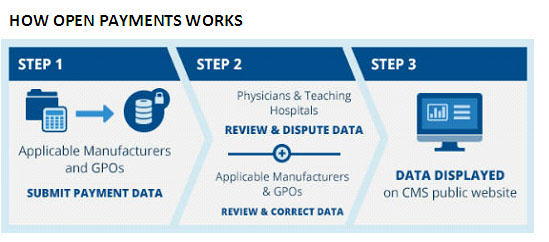
Registration with CMS to receive notifications and information submitted by Manufacturers and GPOs is voluntary. This information is now available on the CMS website, to public and regulators alike, but the website itself continues to present issues of accuracy and ease of on-line accessibility. Physicians and teaching hospital representatives have the opportunity to review and, if appropriate, dispute information reported about them in the Open Payments System (viii).
open payments graph

Source: ttps://www.cms.gov/OpenPayments/About/How-Open-Payments-Works.html

It has been necessary to resolve a number of procedural and substantive issues with the reporting requirements including initial confusion about the information that had to be reported and by whom. Example of substantive issues to be resolved may be helpful is understanding the regulatory climate. Some confusion has surrounded the CMS treatment of payments related to continuing medical education. “Direct payments” have always been included in the Sunshine Act’s reporting requirements. “Indirect payments” refers to payments by a manufacturer to a continuing education organization where the Manufacturer directs that the third party provide the payment or transfer to a covered recipient. In the October, 2014, final regulations, CMS responded to widespread criticism of its treatment of the CME by requiring reporting in 2017 payments (direct and indirect) made to continuing education organizations in 2016 as long as the speaker can be identified (ix). Further, payments to physicians for speaking at CME programs need not be reported if the following conditions are met:

  • The CME program meets accreditation/certification standards of one of the following: (1) the Accreditation Council for Continuing Medical Education; (2) the American Academy of Family Physicians ; (3) the American Dental Association’s Continuing Education Recognition Program; (4) the American Medical Association; (5) the American Osteopathic Association; and
  • The Manufacturer or GPO does not pay the speaker directly; and
  • The Manufacturer or GPO does not select the speaker or provide the third party, such as the CME vendor, with a distinct, identifiable set of individuals to be considered as speakers for the CME program (x).

Other frequent questions concern Manufacturers providing meals and other event support and sponsorships to physicians. In this context the Open Payments program is very specific–e.g., where a Manufacturer’s sales representative brings a meal to a staff meeting or a community education event for a number of persons, the cost of the meal is divided by the number of persons who actually eat the meal and this benefit is reported only if it exceeds $10.00 per person. This does not include meals eaten by support staff. Financial support of buffet meals at large-scale medical conferences is not reportable. The “User Guide” for Open Payments published by CMS is over 350 pages long and provides additional guidance to those reporting and those reviewing reports. It is accessible on-line (xi).

The Open Payments System is expected to significantly impact historic financial support of provider, patient and community education by industry. Importantly, these regulations and reporting requirements echo federal policy designed to avoid improper payments and incentives and market influence. These are the same concerns that spawned the expansion of federal antitrust, Stark and Anti-kickback law within health care.

Ms. Richard is a health care lawyer at Phillips Murrah, P.C. in Oklahoma City and was formerly in house counsel with INTEGRIS Health, Inc.


The Natures of Payment that are of Interest to CMS

Nature of payment Definition Examples
Consulting fee Payments made to physicians for advice and expertise on a particular medical product or treatment, typically provided under a written agreement and in response to a particular business need. These payments often vary depending on the experience of the physician being consulted. Example 1: Company A has developed a drug to treat patients with a particular disease and wants advice from physicians on how to design a large study to test the drug on patients. Dr. J has a large number of patients with this disease and has experience doing research on how well medicines work for this condition. Company A asks Dr. J if he would spend about 10 hours per month to work with other physicians to create a new research study. Dr. J agrees and is paid for his time.Example 2: Company C has designed a new tool for surgeons to use when they are doing heart surgery. The company pays some physicians to give the new tool a “test drive” on a computer-simulated patient at the company headquarters. The physicians are paid an hourly fee for their time testing the tool and giving advice on how to make it work better. They are also paid for flights, hotel rooms and meals.
Compensation for services other than consulting, including serving as faculty or as a speaker at an event other than a continuing education program. Payments made to physicians for speaking, training, and education engagements that are not for continuing education. A physician who frequently prescribes a particular drug is invited by the company that makes that drug to talk about the medicine to other physicians at a local restaurant.  The physician is paid for preparation time as well as the time spent giving the talk.
Honoraria Similar to consulting fees, but generally reserved for a one-time, short duration activity. Also distinguishable in that they are generally provided for services which custom prohibits a price from being set. A medical device manufacturer representative goes to a medical meeting and asks some physicians there for an hour of their time to talk about features they would like to see to improve a particular device. This representative pays each physician a one-time honorarium.

Footnotes:

(i) The Physician Payment Sunshine Act is Section 6002 of the Patient Protection and Affordable Care Act, 42 U.S.C.§18001. The regulations can be found at: http://www.cms.gov/OpenPayments/Downloads/Affordable-Care-Act-Section-6002-Final-Rule.pdf.

(ii) There are specific reporting thresholds for applicable manufacturers and GPOs. The Open Payments reporting thresholds are adjusted based on the consumer price index. This means that for 2015 (January 1 – December 31), if a payment or other transfer of value is less than $10.21 ($10.00 for 2013, $10.18 for 2014), unless the aggregate amount transferred to, requested by, or designated on behalf of a physician or teaching hospital exceeds $102.07 in a calendar year ($100.00 for 2013, $101.75 for 2014), it is excluded from the reporting requirements under Open Payments. http://www.cms.gov/OpenPayments/Program-Participants/Applicable-Manufacturers-and-GPOs/Data-Collection.html.

(iii) This law applies to physicians and other providers, but, for the purposes of this article, we will only reference physicians. The other providers as defined in Section 1861(r) of the Social Security Act to whom this law applies include medical and osteopathic physicians, dentists, podiatrists, optometrists and chiropractors. Providers exempted include medical and osteopathic residents, physician assistants, nurse practitioners and allied health practitioners. However, in some circumstances, payments to these types of providers may be imputed to physicians, thereby triggering the Manufacturers’ obligations to report payments.

(iv) Manufacturers and GPOs may also be referred to in this paper as “covered recipients.”

(v) https://openpaymentsdata.cms.gov/.

(vi) http://www.cms.gov/OpenPayments/About/Resources.html

(vii) The American Medical Association offers a toolkit for physicians to use in reviewing and dispute reports at: http://www.ama-assn.org/ama/pub/advocacy/topics/sunshine-act-and-physician-financial-transparency-reports/sunshine-act-toolkit.page?

(viii) See Flow Chart 1 in content.

(ix) 42 C.F.R. §403.902.

(x) 42 C.F.R. §403.904(g).

(xi) www.cms.gov/Regulations-and-Guidance/Legislation/National-Physician-Payment-Transparenct-Program/Download/Open-Payments-User-Guide-%5BJuly-2014%5D.pdf.